Origins · Where the Island Came From8 essays
01
Raffles was not a discoverer. He was a visitor with a signed agreement.
On 28 January 1819 Stamford Raffles landed at the mouth of the Singapore River. The island held somewhere between a few hundred and a thousand people, mostly Malays, Chinese and Orang Laut - the sea people - under the suzerainty of the Johor Sultanate and governed in practice by the Temenggong.
Raffles did not conquer the place. He signed a treaty with the Temenggong and with Sultan Hussein, installed in place of the older ruler, and obtained permission to set up a trading post in exchange for annual payments and an acknowledgement of the Sultan's overlordship. The document was legally contested and, in effect, remarkably successful.
The phrase Raffles discovered Singapore is a later construction. The island had been here for centuries. Fourteenth-century Chinese records call it Temasek; the Malay Annals name a place called Singapura. What Raffles contributed was not discovery but selection. He judged that the depth of water, the position and the neutrality of the place could displace Penang and Dutch Malacca.
Dating a city's origin to one man's decision hides the harder and truer part. What turned a trading post into a city was the several thousand merchants, boatmen, farmers and craftsmen who arrived over the following years, most of whom left no name behind.
Origins · Where the Island Came FromNo. 01
02
The treaty's borders were far smaller than today's national boundary.
In 1824 a second treaty ceded the entire island to the British East India Company, with lifetime annuities for the Sultan and the Temenggong. Arrangements of this kind were not unusual in the Malay world of the period, but this one fixed a framework with long consequences: sovereignty over land and sovereignty over people were separated, then transferred.
What the treaty left unsettled was who actually held the land. Kampong residents had farmed, fished and tapped rubber for generations with no notion of a title deed. Once the British land registry arrived, large areas of customary use were redefined as Crown land or as land without an owner.
The effects run to the present. More than 80 percent of the island is state land, assembled through compulsory acquisition, reclamation and purchase. That gives the government unusual executive capacity in planning, housing and infrastructure. It is also the condition underneath the HDB programme, the MRT alignments and the reclamation scheme.
Only with that in view does it make sense that the island could be redrawn inside one generation. The question was never efficiency. It was the structure of property.
Origins · Where the Island Came FromNo. 02
03
The island's first fortune came from doing nothing.
Nineteenth-century Singapore had no hinterland, no minerals and no plantations. Its only product was position: the eastern mouth of the Strait of Malacca, deep water, a monsoon you could set a calendar by.
The logic of entrepot trade was simple. Pepper from Sumatra, tin and gambier from the Malay Peninsula, rice from Siam, tea and silk from China, cloth from India - all of it landed here, was regraded, repacked and shipped out again. Cargo changed ships, marks and currencies. Singapore took the spread, the commission and the storage fee.
To keep the flow moving, the island adopted free port status: no duties on imports or exports beyond a short list of goods. That was radical for the nineteenth century. It gave up the easiest revenue and bought volume instead. By the early twentieth century Singapore was a principal world market for rubber and tin.
The gene has not changed. Singapore is now the second-largest container transshipment port in the world; oil refining and petrochemicals, electronics and pharmaceuticals all pass through it. It still makes few finished products. It still earns by passing through.
Origins · Where the Island Came FromNo. 03
04
These three syllables are the hardest block in the national story.
On 15 February 1942 the British surrendered Singapore to the Japanese army. Some 80,000 Commonwealth troops became prisoners of war. It was the largest capitulation in British military history, and it ended the colonial myth that white soldiers could not be beaten.
The Japanese renamed the island Syonan-to, the Light of the South. The occupation brought the Sook Ching screenings, in which tens of thousands of Chinese were identified, taken away and killed. The exact number is still unsettled; official and academic estimates run between 20,000 and 50,000.
Three years and eight months changed the political psychology. Britain came back after the war, but its legitimacy had been damaged. Local elites drew the conclusion that an external protector was an unreliable arrangement, and that conclusion led straight to the later demands for self-government and then independence.
The Syonan-to gallery, in the former Ford motor factory, keeps the record. Its place in the national narrative is explicit: not an indictment of a people, but proof of a proposition - that we have to be able to defend ourselves.
Origins · Where the Island Came FromNo. 04
05
Inside two years a country was founded and then left.
On 16 September 1963 Singapore joined Malaya, Sabah and Sarawak in the Federation of Malaysia. The motives were economic and strategic. Singapore needed a hinterland market, and it needed relief from pressure on the left and from Indonesia's Confrontation.
The cracks opened quickly. The federal government feared that the Chinese share of the population would shift the communal balance, and the two sides fought continuously over revenue shares, the common market and political direction. In 1964 communal riots in Singapore killed and injured dozens.
On 9 August 1965 Singapore was expelled from the federation and became independent. Lee Kuan Yew weeping on television became the most reproduced frame in the country's public memory. The new state was fragile on every count: no resources, no army, no hinterland, a housing shortage, high unemployment, tense neighbours.
Independence was not a design. It was a compulsion. That fact explains the extreme pragmatism of the decades that followed, when every policy was measured against a single question: will this let the country survive.
Origins · Where the Island Came FromNo. 05
06
Public housing was never only housing policy. It was state-building.
In 1960 the Singapore Improvement Trust was wound up and the Housing and Development Board (HDB) was created. The island held about 1.6 million people, many of them in crowded shophouse cubicles and squatter settlements with bad sanitation and frequent fires.
The first five-year plan built just over 50,000 flats; the second added more than 60,000. To hold costs down the early blocks were austere: rectangular plans, shared corridors, open ground floors. But they answered the urgent question - a roof, piped water, electricity, a private toilet.
The deeper design was ownership. The Home Ownership Scheme of 1964 allowed residents to use Central Provident Fund (CPF) savings for the down payment and the monthly instalments on the flat they already lived in. Housing turned from a benefit into an asset, and the citizen's balance sheet became tied to the state's.
Today about 80 percent of residents live in HDB flats and about nine in ten own them. The estates are at once constituencies, communities and laboratories of mixing: the ethnic integration policy introduced in 1989 sets quotas per block so that enclaves cannot form.
Origins · Where the Island Came FromNo. 06
07
The country is getting larger, and the material is sand.
At independence in 1965 Singapore covered about 581 sq km. It now covers about 735 sq km, and nearly all of that extra quarter came out of the sea.
The fill came first from hillsides and seabed mud, later from imported sand. In the 1990s Singapore was one of the largest importers of sand in the world, drawing mainly on Indonesia, Malaysia and Cambodia. Several countries then restricted exports over environmental and sovereignty disputes, which pushed Singapore towards Vietnam, Myanmar and more distant sources, and towards techniques that combine reclamation with dykes.
Reclamation is a planning instrument, not merely extra ground. Most of Changi Airport, Jurong Island with its petrochemical plants, Marina Bay with its banks, and the beaches of Sentosa are all built up. In the 1970s Marina Bay was open water. It is now the most expensive address in the country.
The costs are real. Fill changes currents and sediment, and with them the ecology and fishing grounds of neighbouring waters; Malaysia and Indonesia have raised boundary and sand-source objections repeatedly. It is an extreme case of trading engineering for space.
Origins · Where the Island Came FromNo. 07
08
The country's account of itself rests on a narrow escape.
The national story runs on a clean arc: from a third-world fishing village to a first-world city in a single generation. GDP per head went from about US$500 in 1965 to more than US$80,000 today.
The arc was carried by specific instruments: investment promotion, with Jurong Industrial Estate from 1968; universal schooling with English as the medium; public housing and the CPF; and a public administration of unusual discipline. The common thread was sequence - survive first, argue afterwards.
The same story produces a permanent unease. Resources are imported, water and food among them. The population depends on immigration. The economy depends on external markets. Three dependencies stacked together made vulnerability the most frequent word in public argument.
In policy the anxiety shows as an obsession with reserves, with education rankings and with defence - national service since 1967, two years for every male citizen. It explains the efficiency. It also explains why this society has a low tolerance for uncertainty.
Origins · Where the Island Came FromNo. 08
Plural · Four Languages, One Island7 essays
09
The national language is Malay. The office runs on English.
Singapore has four official languages: English, Malay, Mandarin and Tamil. Malay is the national language, and the anthem, Majulah Singapura, is sung in Malay. But the working language of government, the courts and business is English.
The arrangement is a product of pragmatism. English was neutral, so it avoided picking a side among the three major communities, and it connected the port to global trade. It remains one of the city's core competitive advantages.
Bilingual policy began in 1966. Every student takes English as a first language and studies a mother tongue - Chinese, Malay or Tamil - as a second. The intention was to keep a cultural anchor. The result was a two-tier structure with English on top.
The cost is a general decline in mother-tongue competence. Young Mandarin often carries English word order; Malay and Tamil have narrower daily domains. The Speak Mandarin Campaign and Malay Language Month are, at bottom, policy trying to hold up something the market will not.
Plural · Four Languages, One IslandNo. 09
10
They came from different places and spoke different languages.
Chinese Singaporeans are about three-quarters of residents, but the category conceals wide differences. Hokkien, Teochew, Cantonese, Hakka, Hainanese, Foochow and Henghua communities each kept their own clan associations, temples, dialects and food.
Migration from the nineteenth century into the early twentieth ran on chains. Those already here provided lodging and work, then sent for people from the same district. Neighbourhoods formed by origin: Hokkiens around Amoy Street and Telok Ayer, Teochews at Boat Quay and Clarke Quay, Cantonese in Chinatown, Hainanese along Beach Road.
Dialects were systematically squeezed after independence. The Speak Mandarin Campaign from 1979 promoted putonghua, and television and radio dropped dialect programming. Talking across dialect groups became easier. Dialect opera, ballads and oral literature largely disappeared.
There is a turn back. Clan associations run dialect classes, and younger people relearn Hokkien and Teochew from podcasts and short video. It is rescue work rather than revival - not because the language is needed every day, but because its disappearance has become visible.
Plural · Four Languages, One IslandNo. 10
11
The constitution recognises Malays as the indigenous people of Singapore.
Article 152 of the constitution recognises the special position of Malays as the indigenous people of Singapore and makes the state responsible for their political, educational, religious, economic and social interests. The clause has substance. It is not ornament.
The Malay roots here run deeper than the colonial city. Before Raffles the island belonged to the Johor Sultanate, and its people were mainly Malays and Orang Laut. The Sultan Mosque and the remains of the royal palace in Kampong Glam are the physical evidence of that order.
Institutional support appears at several levels: Malay as the national language; Islamic affairs under the Islamic Religious Council of Singapore (MUIS); ethnic quotas in HDB estates to prevent isolation; and dedicated educational funding through bodies such as Yayasan Mendaki.
The socio-economic indicators still show a gap. Median household income for Malay families sits below the national figure, and university enrolment is lower. It is a problem openly discussed, consistently funded and not yet closed.
Plural · Four Languages, One IslandNo. 11
13
They were not mixed. They were made here.
Peranakan, or Baba-Nyonya, describes the community formed by early Chinese male migrants who married local Malay and Indonesian women, concentrated in Malacca, Penang and Singapore. The culture took shape in the eighteenth and nineteenth centuries, and its language was Baba Malay, salted with Hokkien words.
What made the community distinct was the double culture. The men, the babas, were usually English-educated and worked in trade and in British firms. The women, the nyonyas, ran the household, the kitchen and the crafts, and produced a cuisine, beaded slippers called kasut manek, batik and porcelain that are recognisable at a glance.
In architecture the Peranakan shophouse mixes Chinese woodcarving, Malay eaves, Victorian tilework and ironwork. The painted terrace houses along Joo Chiat and Koon Seng Road are the most complete surviving sample of that mixture.
The community faded quickly from the middle of the twentieth century. English displaced Baba Malay, public housing broke up the old streets, and the young mostly married into the wider Chinese population. What remains is held up by a museum, a handful of restaurants and the memory of a few families.
Plural · Four Languages, One IslandNo. 13
14
They were here before the country was.
Eurasian describes the community of mixed European and Asian descent, present in Singapore since the Portuguese arrived in the sixteenth century. Most came by way of Malacca and Penang, moving along British administrative and commercial networks.
Their markers include Catholicism, a Portuguese-Malay creole known as Kristang, and a distinct table - debal curry, sugee cake. The Katong area remains the cultural centre of the community.
The population is small, about 1 percent of residents, and has long sat at the edge of the public story. Yet Eurasians staffed much of the middle layer of colonial administration, teaching and the churches, and were the practical intermediaries between the colonial state and local society.
The Eurasian festival and the Kristang revival classes of recent years belong to the same effort: to write the name down before a larger story covers it.
Plural · Four Languages, One IslandNo. 14
15
The country has always taken immigrants. The question is who, and how many.
About 40 percent of residents were born abroad. Non-residents - work pass holders, dependants, students - are roughly 30 percent of the total population. Construction and marine draw mainly on Bangladesh, India and Myanmar; services and domestic work mainly on the Philippines, Indonesia and Myanmar.
Policy sorts migration into clear tiers: the top, on Employment Passes from S$5,600 a month and higher in finance; the middle, on S Passes; the bottom, on Work Permits managed by sector and by source-country quota. Each tier carries different rights to stay, to bring family and to change employer.
The criteria for permanent residence and citizenship are not published, but the preference is visible: higher qualifications, higher income, capacity to fit in, and a balancing of the ethnic mix. Becoming Singaporean is therefore a path that exists and a process that cannot be read.
Public feeling is contradictory. The official line is that everyone here descends from migrants. Local resentment over housing, job competition and the sound of the language is equally real. The tension comes up at every policy adjustment.
Plural · Four Languages, One IslandNo. 15
Faith & Festivals6 essays
16
The temple came first. The street followed.
Most Chinese temples here were built in the nineteenth century and, with clan associations, burial grounds and schools, formed the organisational core of migrant society. Thian Hock Keng on Telok Ayer, completed in 1840 by the Hokkien community, was the seat of power in early Chinese Singapore. Yueh Hai Ching Temple, from 1826, belonged to the Teochews. Earth god shrines stood in every district.
The functions went well beyond worship. Temples registered new arrivals, settled disputes, gave temporary lodging, paid for funerals and funded schooling. The self-government of nineteenth-century Chinese society ran largely through temples and clan halls.
In construction, the swallowtail ridges, cut-and-paste ceramic figures, stone carving and timber framing of southern Fujian crossed the sea with the migrants. The dragon columns and the coffered ceiling at Thian Hock Keng are equal in workmanship to work made in Fujian in the same years.
Today the temples carry a double identity: place of worship and heritage asset. The race for the first incense stick at Lunar New Year, the Hungry Ghost rites and the Nine Emperor Gods festival still draw crowds, while the buildings sit inside conservation areas where repairs must follow conservation standards.
Faith & FestivalsNo. 16
17
Five times a day, the sound passes over the shophouses.
Singapore has about 70 mosques. The oldest is Masjid Sultan in Kampong Glam, built in 1824 and rebuilt in 1932, its gold dome the marker for the whole district.
In the colonial period a mosque also handled community registration, schooling, charity and mediation, much as a Chinese temple did. After independence, Islamic affairs came under MUIS, which now covers halal certification, the haj quota and religious education.
The architectural language runs from early Malay and Indo-Islamic forms to later Arab-style domes and minarets. The shophouses of Kampong Glam and the perfume and textile shops on Arab Street complete the community's physical setting.
At Hari Raya the market at Geylang Serai is among the largest festive markets on the island, running from dusk into the night. It is the Malay community's most concentrated public appearance of the year.
Faith & FestivalsNo. 17
18
Here the deities are carried into the street.
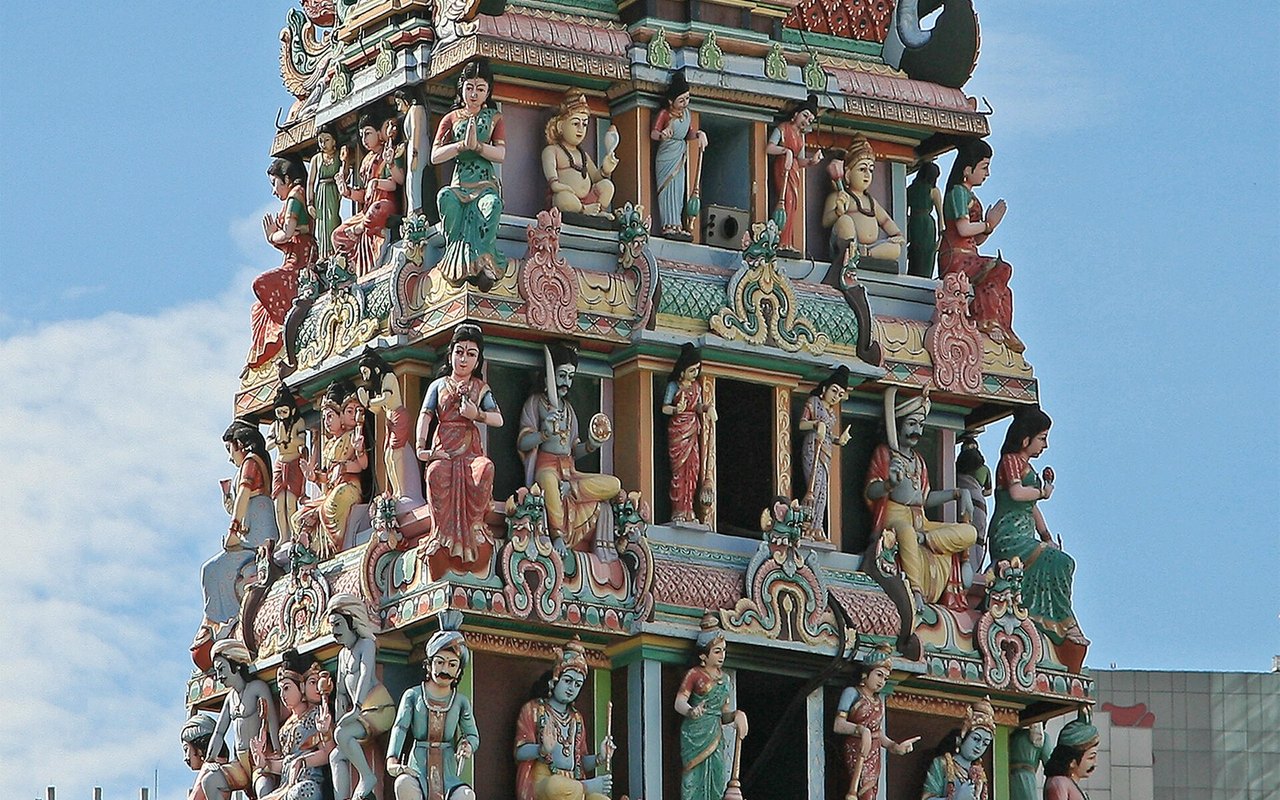
There are about 30 Hindu temples in Singapore. The best known are Sri Mariamman Temple in Chinatown, founded in 1827, and Sri Thendayuthapani Temple on Tank Road, from 1859.
The south Indian Dravidian gopurams rise in tiers of painted figures, set on the same block as Chinese shophouses, a mosque and a church. This part of Chinatown has the densest concentration of religious buildings on the island.
Of the rituals, Thaipusam draws the most attention. Devotees carry a kavadi - a steel or wooden arch fixed to the body with hooks and skewers - from Little India to the temple on Tank Road, several kilometres on foot. It is an act of fulfilment and thanks. It is not a performance.
The practical problems now are space and noise. As the surrounding housing has thickened, processional routes, the volume of drums, and the smoke of incense and oil lamps all have to be negotiated with residents. It is the most ordinary kind of bargaining in a plural society.
Faith & FestivalsNo. 18
19
One faith, three languages.
Christianity here covers Catholic, Anglican, Presbyterian, Methodist, Baptist and a large number of independent churches. St Andrew's Cathedral, from 1861, is the colonial Gothic landmark of the civic district, its white spire visible across the Padang.
The churches' historical role in education and health was large. Several of the best-known schools and hospitals were founded by churches, which kept the church network woven into the local elite for generations.
In language, the churches became an unexpected archive of dialect. Some still hold services in Hokkien, Teochew or Cantonese because the older members know nothing else. In that sense a church is a living record of a language.
The fastest growth recently has been in large independent churches and migrant congregations - Filipino, Indonesian, Korean and Chinese newcomer. On Sundays around Little India and Paya Lebar, Filipino congregations gather in shopping malls and theatre spaces.
Faith & FestivalsNo. 19
20
The Gregorian, lunar, Islamic and Indian calendars all run at once.
The public holidays reflect four traditions: New Year, Lunar New Year, Hari Raya Puasa, Deepavali, Good Friday and Christmas, plus National Day and Labour Day. It is a carefully balanced list.
Lunar New Year is the largest Chinese festival: the Chinatown market, lo hei, red packets, the reunion dinner. The tossing of yusheng, with its shouted phrases and the rule that the higher you lift the strands the better the year, is a local invention. It does not match practice in Fujian or Guangdong.
Hari Raya Puasa and Hari Raya Haji follow the Islamic calendar and move about eleven days earlier each year. Deepavali fills Little India with lights and stalls. Thaipusam is not a public holiday, but its procession is one of the largest on the island.
A calendar with four kinds of time running in parallel is the most concrete technical solution a plural society has. Nobody is asked to give up their own rhythm. Each is asked to know when the neighbours keep theirs, and to adjust work and traffic accordingly.
Faith & FestivalsNo. 20
21
Singapore governs religion by law, and protects it by law.
In 1950 the Maria Hertogh riots killed 18 people in communal and religious violence. The episode led, four decades later, to the Maintenance of Religious Harmony Act of 1990.
The act allows the Minister for Home Affairs to issue restraining orders against anyone who stirs up religious hatred or uses religion for political mobilisation. Amendments in 2019 added provisions on foreign interference and on transmission online.
The design is not a strict separation of church and state but cooperation between them. Religious bodies do real work in charity, education and social service; the state keeps order through grants, land and regulation.
The model is efficient. The price is that public religious expression is drawn inside fairly narrow lines. For a resident, the practical experience is this: every religion is respected, and none is encouraged to claim exclusivity in public.
Faith & FestivalsNo. 21
Craft & Object6 essays
22
Five-foot way, air well, louvred shutter - the design answers the tropics.
The shophouse is the standard building type of the Southeast Asian city: a narrow frontage, usually 4 to 6 metres; a deep plot, up to 30 metres; two or three storeys, with trade below and living above. About 6,500 conserved shophouses remain in Singapore.
The key device is the five-foot way. The ground floor is set back about 1.5 metres to make a continuous covered walkway, so a pedestrian can cross a whole street out of the sun and the rain. The rule is attributed to Raffles's town instructions of 1822, which required every building to provide a covered passage.
Air and light come from the air well and from high windows. In a deep plot an internal courtyard sets up a chimney effect; timber louvres can be angled for shade, ventilation and privacy at the same time. Before air conditioning the system worked extremely well.
In ornament the shophouse mixes Chinese woodcarving, Malay eaves, Victorian tiles, Art Deco lines and coloured plasterwork. The facades along Joo Chiat, Tiong Bahru, Keong Saik Road and Amoy Street differ from one another and share a single spatial logic.
Craft & ObjectNo. 22
23
None of it was made to be shown to outsiders.
Nyonya ware is the famille rose porcelain commissioned by Peranakan households from the nineteenth century into the early twentieth, mostly fired in Jingdezhen and decorated to order, with phoenixes, peonies and the eight Buddhist emblems in rose pink, jade green and bright yellow.
It was used in sets: altar vessels, everyday dining ware, and the covered soup tureen made for weddings. Quantity and quality were a direct index of a family's means, and part of the dowry.
Beaded slippers, kasut manek, are the other peak. Glass beads about a millimetre across are sewn on one at a time in floral and geometric patterns. A pair takes several thousand beads and weeks of work.
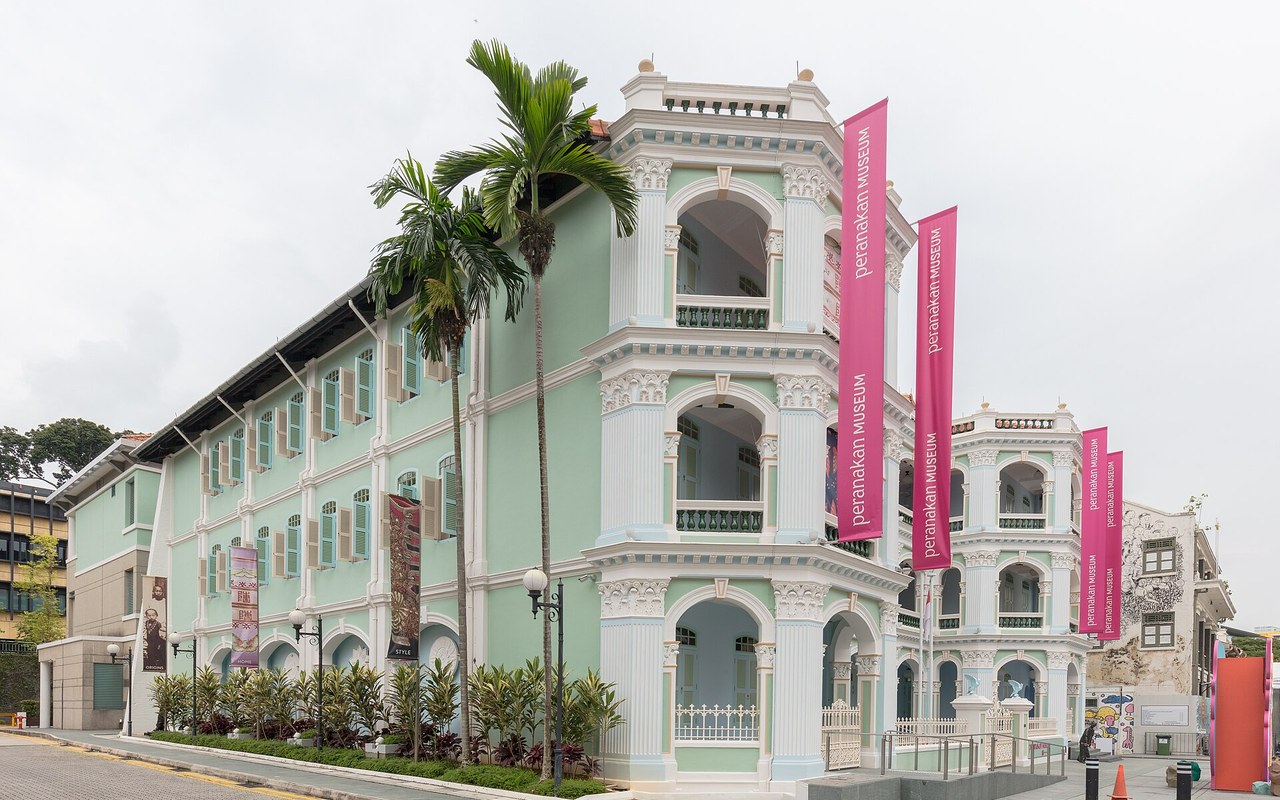
The crafts all but stopped in the later twentieth century as lifestyles changed, materials became hard to find and young women stopped learning. The Peranakan Museum and a few remaining makers keep them alive through workshops, at very small volume.
Craft & ObjectNo. 23
24
Once it was not modern. Now it has roots.
Batik is a wax-resist textile technique that came from Java and reached Singapore through the Malay world. In the middle of the twentieth century the island had a substantial batik trade, supplying local and regional markets.
After independence batik was treated as traditional, which is to say not modern enough, and gave way to suits and shirts on official occasions. Only in the 1980s was it revalued as heritage. It now appears in school events, corporate gifts and tourist goods.
Technically, hand-drawn batik uses a copper pen, the canting, to lay the wax, and a single cloth takes days. Most production now uses stamps or screen printing: cheaper, but without the fine crackle that appears where the wax breaks.
Local designers have begun putting batik into contemporary clothing and interiors, and the argument is where adaptation ends and distortion begins. Every post-colonial society has this argument. The answer is rarely about the craft. It is about who gets to define the orthodox.
Craft & ObjectNo. 24
25
Singapore coffee has its own grammar.
Local kopi uses robusta beans roasted to near black in a wok with margarine or sugar, brewed through a long cloth sock and finished with condensed or evaporated milk. Hainanese migrants brought the method, and it spread through the kopitiam, the coffee shop, in the early twentieth century.
The ordering vocabulary is a complete code: kopi for condensed milk, kopi-o for black with sugar, kopi-c for evaporated milk, kopi-peng for iced, kosong for no sugar. The abbreviations work in Singapore and Malaysia alike and are close to unreadable to a visitor.
From the 1990s chains and specialty roasters arrived, and pour-over, single origin and light roast became middle-class routine. The old kopitiam faces succession: the owner retires, the children decline, the rent rises.
What is interesting is how the two coexist. In the same shophouse one shop sells kopi-o at S$1.30 and the next sells a flat white at S$7. Customers take what they want and rarely comment on each other. That juxtaposition is the normal condition of consumption here.
Craft & ObjectNo. 25
26
A city's letters are more honest than its buildings.
The hand-painted signs, metal letters and carved timber plaques of the old districts record several generations of commercial habit. Chinese medicine shops in Chinatown used gilt wooden boards; textile shops in Little India set Tamil beside English; perfume shops in Kampong Glam used Arabic and Jawi script.
Between the 1960s and the 1980s the government pushed standardisation: fixed sizes, limits on projections, bilingual requirements. Safety and tidiness improved. A great deal of handwork was sanded away.
Conservation areas such as Joo Chiat, Tiong Bahru and Keong Saik now review signs more strictly and require them to sit well with the traditional facade. New businesses answer with discreet metal letters or a painted look that will pass approval and still read as an old street.
What is worth recording is what is going: hand-painted cinema posters, old neon, shop names that are Hokkien puns. None of it reaches the level of heritage listing, and none of it has a substitute once it is gone.
Craft & ObjectNo. 26
27
Before the supermarket, this was how the day was planned.
The pasar, from the Malay word for market, is the traditional wet market, selling fresh meat, live fish, vegetables, dried goods and spices. Most sit in the same building as a cooked food centre, which fixes the routine: buy downstairs, eat upstairs.
The rhythm starts early. Stallholders take delivery at three or four in the morning, open at five, serve the household rush until about ten, and wind down after noon. Fishmongers break fish down by hand on ice; butchers cut to order. That ability to specify is what the supermarket cannot replace.
There is little room to bargain, but regulars get small favours: an extra spring onion, the change rounded down, a good fish set aside. This informal economy is the social fabric of the neighbourhood.
The pressure comes from two sides. The young will not take over the stalls, and supermarkets and online grocers take the volume. Rent rebates and revitalisation programmes keep the markets running, but the average age of a stallholder keeps rising.
Craft & ObjectNo. 27
The Table · A Republic of Hawkers8 essays
28
In 2020 it was inscribed on the UNESCO list.
Singapore has more than a hundred hawker centres and tens of thousands of stalls. They are built and managed by the National Environment Agency (NEA), let at below-market rents, and in some cases carry price ceilings on basic dishes.
The system began as a way of housing street vendors. Through the 1960s and 1970s the government moved itinerant hawkers into centralised buildings with water, drainage and seating. It was a public health programme and a programme of urban order at the same time.
In 2020 hawker culture in Singapore was inscribed on the UNESCO Representative List of the Intangible Cultural Heritage of Humanity. The nomination stressed the hawker centre as a community dining space and a setting for everyday coexistence across communities, not the recipe of any single dish.
The problem now is succession. Stallholders are old, few young people want in, and the Michelin Bib Gourmand listings that brought fame also brought rent and queues. It is a system that was defined successfully and is now paying for that success.
The Table · A Republic of HawkersNo. 28
29
It comes from Hainan. It was formed in Singapore and Malacca.
The ancestor is Wenchang chicken from Hainan, served with rice cooked in chicken fat. Hainanese migrants brought it south in the early twentieth century, and it evolved in coffee shops and street stalls.
The Singapore version rests on three things. The chicken is poached, then plunged into iced water so the skin sets and the meat stays soft. The rice is cooked with chicken fat, ginger, garlic and pandan. The condiments arrive as three saucers: ginger paste, chilli sauce and dark soy.
The Malaysian version, especially in Malacca and Penang, often forms the rice into balls. That is rare here. It is one concrete marker of the divergence between the two cuisines.
Tian Tian at Maxwell, Boon Tong Kee and Chatterbox at the Mandarin Oriental each have their following. Prices run from S$3.50 at a stall to S$30 in a hotel. The method barely differs. What differs is the chicken, and the hand with the rice.
The Table · A Republic of HawkersNo. 29
30
It is seventy years old and already a national dish.
In the 1950s Cher Yam Tian and her husband Lim Choon Ngee sold stir-fried crab from a pushcart along the Rochor seaside, first with bottled chilli sauce and tomato ketchup, later with fresh chillies and a ribbon of egg. That was the beginning of chilli crab.
In 1963 they opened Palm Beach Seafood at Toa Payoh, and the dish moved into restaurants. After that Jumbo, Long Beach, Roland and No Signboard each developed a version of their own.
The sauce is the whole point: chilli, tomato, garlic, ginger, plum sauce and egg, thick enough to cling to the shell. It has to be eaten with fried mantou, for dipping.
It is sold by weight, mostly Sri Lankan crab, at about S$60 to S$110 a kilogram; a crab for two usually lands near S$120. It is one of the few national dishes here that is expensive for a good reason.
The Table · A Republic of HawkersNo. 30
31
Each side denies that the other is real.
Bak kut teh, Hokkien for pork bone tea, is pork ribs simmered in a medicinal broth, served with rice or fried dough sticks. One account traces it to Yongchun in Fujian, another to labourers at Port Klang in Malaysia. Both have evidence.
The Singapore mainstream is the pepper camp: a clear broth, heavy with white pepper and whole garlic. Song Fa, Founder, Ng Ah Sio and Ya Hua are the reference names. Around Klang the herb camp dominates: a dark broth tasting of angelica and codonopsis. Each side regards the other as heresy.
In Singapore it comes with white rice, you tiao, braised pork trotter and pickles, and a pot of tieguanyin or pu'er. In Malaysia the broth is often poured over the rice.
The dish has a fixed place in the day: breakfast and supper. A bak kut teh shop opening at six in the morning is, for many people, the first evidence that this is a country that gets up early.
The Table · A Republic of HawkersNo. 31
32
Katong laksa is eaten with a spoon, not chopsticks.
Laksa is a family of noodle dishes across the region. The Singapore signature is Katong laksa: a coconut curry broth with dried shrimp, fish cake and bean sprouts, the rice noodles cut short so that a spoon is enough.
The contrast with Penang asam laksa is sharp. Penang uses fish broth and tamarind, sour first, with no coconut. Singapore and Malacca use coconut milk, thick and sweet. It is one of the lines drawn between two food identities.
Among the well-known shops, 328 Katong Laksa and Janggut Laksa have argued for decades about which is the original. The argument has become part of the dish.
The broth is built slowly from dried shrimp, galangal, lemongrass, turmeric, chilli and coconut. Fish cake and cockles are standard; some shops have switched to clams on food-safety grounds.
The Table · A Republic of HawkersNo. 32
33
Soft eggs, dark soy, white pepper - the combination has no home village.
Kaya is a jam of coconut milk, egg, sugar and pandan, spread on charcoal-toasted bread and eaten with soft-boiled eggs and coffee or pulled tea. The set is standard in Singapore and Malaysia and is usually called the kopitiam breakfast.
Charcoal gives the toast a scorched edge, and the kaya should be cooked fresh and thick. The eggs are cracked into a bowl, dressed with dark soy and white pepper, stirred, and used as a dip. This is the step visitors understand last and need most.
Chains such as Ya Kun, trading since 1944, Killiney since 1919, and Toast Box standardised the set and exported it. Older shops such as Heap Seng Leong still use a charcoal stove and the old furniture, and charge less.
The purpose of the meal is clear: fast, cheap, filling. It is not cuisine. It is infrastructure.
The Table · A Republic of HawkersNo. 33
34
It is the one food this city serves around the clock.
Roti prata descends from the South Indian parotta and was reworked by the Indian Muslim, or Mamak, community in Singapore and Malaysia into an all-day staple.
The dough is thrown and folded again and again to build layers, then fried on a flat griddle until crisp outside and soft within. It comes with mutton, chicken or fish curry, or with sugar. The variations include egg, onion, cheese and, lately, durian.
The Mamak stall is the core of the city's night economy: open 24 hours, serving prata, mee goreng and teh tarik. For shift workers, taxi drivers and students, it is the one place that never closes.
Mr and Mrs Mohgan's is known for the crispness, alongside Casuarina Curry, Springleaf Prata Place and The Roti Prata House. Prices run from S$1.20 for plain to S$8 for the elaborate versions.
The Table · A Republic of HawkersNo. 34
35
There is no menu, only the lines on the wall.
Zi char, Hokkien for cook and fry, means a stall-style restaurant built on fast wok work, usually one unit rented inside a coffee shop or hawker centre, serving dozens of dishes: Hokkien mee, char kway teow, butter chicken, herbal prawns, fish head steamboat.
The business is usually a family: the father at the wok, the mother at the till, the children carrying plates. The menu is written on the wall or a whiteboard, priced small, medium or large, with no weights given.
Ordering follows local consensus. One dish per person, one meat, one vegetable and one soup as the base, then a fried rice or bee hoon to close. The bill usually lands between S$15 and S$30 a head.
Keng Eng Kee in Bukit Merah, JB Ah Meng in Geylang, Two Chefs and the Johor-style kitchens are the names people cite. The main risk is succession: the kitchen is hot, the hours are long, and the young generally decline.
The Table · A Republic of HawkersNo. 35
Voice & Memory6 essays
36
It has a grammar, and the grammar is stable.
Singlish is the local variety of English, drawing its vocabulary from English, Hokkien, Malay, Tamil and Cantonese. It is not English done wrong. It is a creole with consistent rules.
The grammar is legible. Word order follows Chinese, as in you go where. The copula is dropped: she very nice. Already marks completion: eat already. Sentence-final particles - lah, leh, lor, sia, meh - carry the modality.
The official position was discouragement for a long time. The Speak Good English Movement, from 2000, treated Singlish as substandard. Popular culture kept using it - comedy, film, advertising - and in time built an identity on it.
The attitude has softened. Academics treat it as heritage, and some brands and productions use it deliberately. The tension between official discouragement and popular embrace is now part of the language itself.
Voice & MemoryNo. 36
37
Most Singaporeans have never lived in one.
Kampong means a Malay village, and by extension the low-rise settlement pattern of the pre-independence island: attap houses, fruit trees, a well, a shared yard, neighbours with no doors between them. Clearance from the 1960s to the 1980s removed almost all of it.
The nostalgia now is second-hand. Most of those who invoke the kampong never lived in one; the image arrives through grandparents, television drama and museum displays. That makes it an ideal, cleaned-up past.
The history was messier. Kampongs meant crowding, fire risk, no sanitation and unclear title. The HDB programme was widely accepted precisely because it solved those problems.
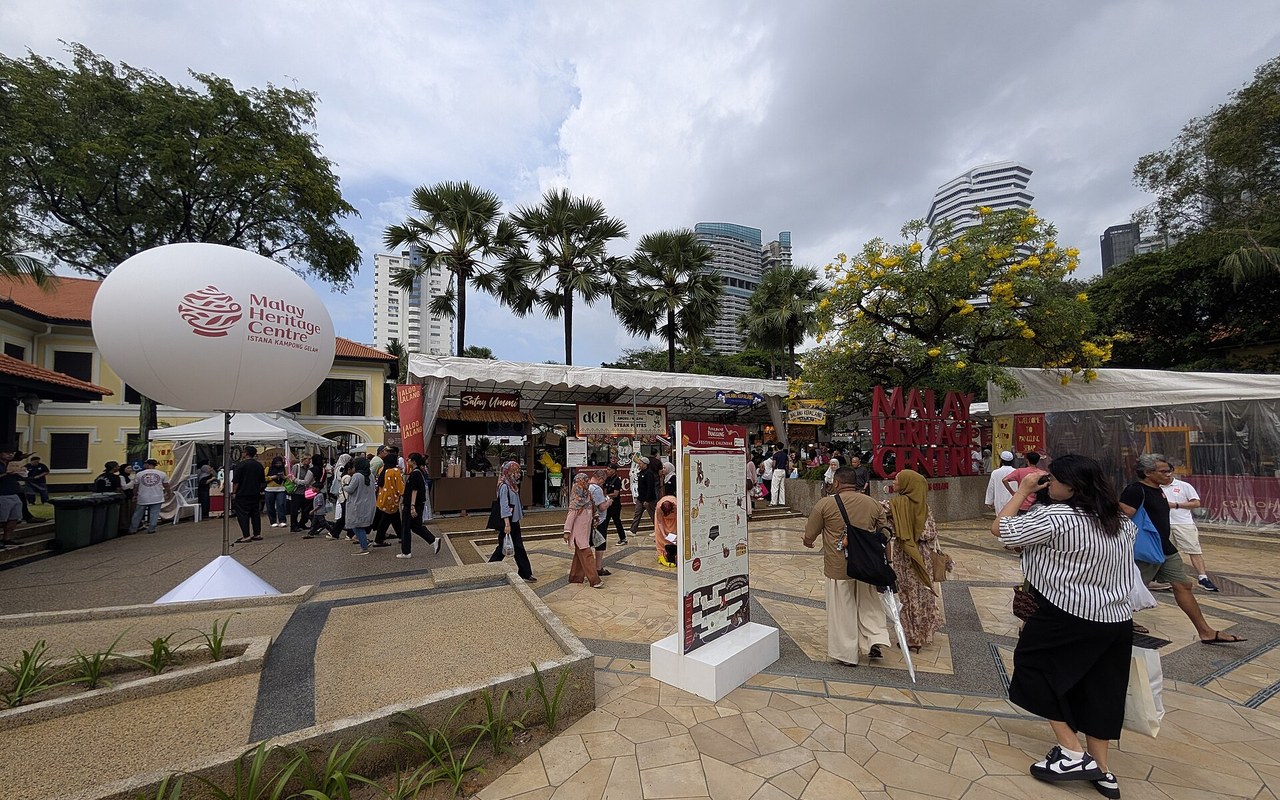
A few fragments remain: the Malay Heritage Centre in Kampong Glam, the kampong houses at Changi, the village on Pulau Ubin. Their function is not restoration. It is a reminder that other arrangements were once possible.
Voice & MemoryNo. 37
38
Before Universal Studios, there were three.
In the middle of the twentieth century Singapore had three large amusement parks: New World, Happy World, later renamed Great World, and Gay World. Each combined cinemas, dance halls, rides, food stalls and markets.
They were genuinely plural spaces. Chinese opera, Malay bangsawan theatre, Indian song and dance, boxing, beauty contests and night markets shared one compound, and the audience crossed community and language.
Television arrived, land values rose, urban renewal pushed through, and through the 1960s and 1970s all three closed and the sites became housing and shopping malls. Only the names survive, in places like Great World City.
Their disappearance makes a point. Coexistence does not always have to be designed by policy. A mixed space driven by the market can be more natural than a harmony that has been planned.
Voice & MemoryNo. 38
39
A whole generation took its world from a radio set.
From the 1950s to the 1970s Singapore broadcasting ran in four languages plus a range of dialects: Hokkien, Teochew, Cantonese, Hakka and Hainanese each had fixed slots, carrying news, radio drama, opera and requests.
For a working class that did not read, dialect radio was the main source of information. It also entertained, taught and held communities together, and it produced the first local mass culture.
After the Speak Mandarin Campaign began in 1979, dialect programming was cut back, and by the 1980s it had largely stopped. The stated reason was to reduce interference and concentrate resources on Mandarin and English.
The period is being re-examined. The National Archives has begun systematic collection of dialect oral history and broadcast recordings, which academics call a rescue of the sound. The tapes can be restored. The daily fact of a whole society hearing the news in dialect cannot.
Voice & MemoryNo. 39
40
The history of the hawker centre is kept mostly in speech.
The records of Singapore's hawker centres are thin. Early stalls had no formal contracts; rent, transfer and relocation were arranged by word. To reconstruct sixty years of change in one centre, you have to rely on the stallholders.
The difficulty in taking oral history is the timeline. People remember the year of the flood, the year the street was cleared, the year the licence changed, but not the year on the calendar. The researcher has to cross-check NEA relocation records, old maps and newspaper advertisements.
The content is very concrete: who came first, who swapped places with whom, whose broth was learned from whose, how much the rent rose and when. None of it is in any official file.
The National Archives and the National University of Singapore have done a large number of interviews in recent years. Their value is not that the stories are good. It is that they supply the layer institutional history leaves out: how people actually responded when a policy arrived.
Voice & MemoryNo. 40
41
Downstairs is an address, and also a relationship.
The ground floor of an HDB block is usually left open, the void deck, with no residents and space instead for weddings and funerals, community events, old men at chess, children with a ball, parcels waiting to be collected. It is the most socially significant move in HDB design.
Weddings and funerals share the same space, which is peculiar to Singapore. A Malay wedding tent one day, a Chinese funeral the next, an Indian family's festival the week after. Users apply according to custom and queue for the date.
The arrangement produces a low-intensity, continuous contact. Neighbours know what has happened in each other's homes without being obliged to step in. It is neither the tight village nor the fully anonymous apartment block.
Newer blocks increasingly put shops or community facilities on the ground floor, so there is less void space. That is a choice about land efficiency, and it has raised the obvious question: the space with no stated purpose was exactly where public life happened.
Voice & MemoryNo. 41
How Systems Shape Daily Life5 essays
42
It is the pension, the medical fund and the mortgage at once.
The Central Provident Fund was set up in 1955 as compulsory saving: employer and employee contribute a percentage into a personal account. Rates vary with age; below 55 the combined contribution is about 37 percent.
The money sits in three accounts: Ordinary, for housing, education and investment; Special, for retirement; and MediSave, for health care. The balance belongs to the individual, but withdrawal is tightly restricted.
The effect is direct. Singaporeans can retire without a state pension, and household savings are converted into demand for flats and into capital for national infrastructure. It is the standard case study in mandatory-savings social security.
The criticism concentrates on two points. It treats low earners poorly, since a low wage means low saving. And it locks a large share of household wealth into housing, which reduces liquidity in old age. Recent policy has raised subsidies and interest rates for lower-income members.
How Systems Shape Daily LifeNo. 42
43
Every male citizen and second-generation PR goes.
National Service began in 1967. Every male citizen and second-generation permanent resident is called up at 18 for about two years, then passes into the reserve and returns for training until roughly 40.
The background was immediate. Britain announced its withdrawal in 1967, and Singapore had very little time to build a defence force of its own. An Israeli advisory team helped train the early army.
The social function goes beyond the military. NS puts men from different communities, classes and schools into the same unit, which is a forced mixing. Many people's cross-community friendships date from those two years.
The arguments persist: women are not liable, service disrupts study and career, and there is the question of how far service should weigh in citizenship decisions. Each of these returns at every election and every budget.
How Systems Shape Daily LifeNo. 43
44
Water here is not a resource. It is a security file.
Supply rests on what is called the four national taps: local catchment, with about 17 reservoirs and their gathering grounds; imports from Johor under two long agreements, one of which expired in 2011; NEWater, introduced in 2003; and desalination, with the first plant in 2005.
NEWater takes treated used water through microfiltration, reverse osmosis and ultraviolet disinfection to ultrapure grade. Most of it goes to industry and to cooling; a small share is returned to the reservoirs. The public communication was a careful campaign: bottles of NEWater handed straight to visitors to drink.
Desalination is energy-hungry but does not depend on rainfall. The newer plants at Tuas and Marina East run in dual mode, treating either seawater or freshwater, which adds flexibility.
The target is self-sufficiency by 2060. The timetable is political. It answers the deadline pressure on the Johor agreement, the uncertainty of rainfall under climate change, and a standing refusal in this country to be held to ransom.
How Systems Shape Daily LifeNo. 44
45
It changed the shape of competition.
The Group Representation Constituency was introduced in 1988. Candidates run in teams, each team must include at least one candidate from a minority community, and the team with the most votes takes every seat.
The stated reason is minority representation in Parliament, and there is a real basis for it: under single-member seats a minority candidate can lose in a ward where the numbers work against him.
Critics read it differently. The team size raises the entry cost for opposition parties, which must field more people and spend more money. It also turns a vote for a person into a vote for a slate, which weakens individual accountability.
Whatever the verdict, it is one of the key institutions for understanding how politics works here. It achieves two things at once: a floor under minority representation, and a structural organisational advantage for the party in government.
How Systems Shape Daily LifeNo. 45
46
The system keeps changing because the argument never ends.
Singapore education is known for selection. The Primary School Leaving Examination (PSLE) determines secondary placement; historically this ran through the EM1, EM2 and EM3 streams, later renamed Express, Normal Academic and Normal Technical.
From 2024, streaming was replaced by Full Subject-Based Banding. Students take each subject at a level that matches their ability, and the overall stream label disappears. It is the largest structural change in forty years.
The motive was fairness: streaming too early, labels that stuck, and family background weighing too heavily on results. The government has also widened the Direct School Admission (DSA) route to reduce the weight of a single examination.
The other thread is the slogan Every School a Good School, backed by resources. The slogan concedes something: in parents' minds the schools are ranked, and the ranking is real.
How Systems Shape Daily LifeNo. 46
Building Land for the Future4 essays
47
Greenery here is a measurable policy.
The Garden City programme began in 1967 with a visual aim: to make Singapore look different from other developing cities. The method was concrete - plant trees, build parks, require developers to set aside green space.
The instruments include statutory green space ratios, the Park Connector Network, now more than 300 km long, and the Skyrise Greenery incentive, which lets rooftop and vertical planting count towards gross floor area.
In 2020 came City in Nature: by 2030, every household within a ten-minute walk of a park, another 1,000 hectares of green space, and a million more trees.
The results can be measured. Green cover, canopy cover and bird species counts are all rising. It is also the most successful piece of soft power this country has exported. Garden city has become a template for the urban brand.
Building Land for the FutureNo. 47
48
It is a house move that takes thirty years.
Tuas Port is the wholesale relocation of the port. Every container berth in the city and at Pasir Panjang moves west to Tuas, with an eventual capacity of 65 million TEU a year, which would make it the largest automated container port in the world.
Reclamation began in 2013, the first berth opened in 2022, and completion is expected in the 2040s. Automated guided vehicles, remotely operated quay cranes and a single scheduling system mean very few people per box.
The point of the move is the land left behind. The terminals at Tanjong Pagar, Keppel and Pasir Panjang become the Greater Southern Waterfront, planned for housing, offices and parks, with an area about three times that of Marina Bay.
It is also a move in spatial politics: push industry to the edge and give the waterfront back to living and leisure. For a city this short of land, it is a rare chance to redistribute.
Building Land for the FutureNo. 48
49
The targets were written into specific ministries.
The Singapore Green Plan 2030, published in 2021, breaks the national commitment down across five ministries: transport, industry, energy, buildings and households. The targets include net zero by 2050 and a peak in emissions by 2030.
The measures are specific: all newly registered cars to be cleaner-energy models from 2030; all internal combustion cars off the road by 2040; solar panels across HDB estates; and a carbon tax rising from S$5 a tonne to S$50 to S$80 by 2030.
The carbon tax is the central instrument and the most contested. It raises costs directly for manufacturing and for power, and the economy leans heavily on petrochemicals and data centres. The answer has been transition grants and allowances for carbon credits.
The other route is imported electricity. Singapore plans to import up to 4 GW of low-carbon power from Malaysia, Indonesia and Laos by 2035, about 30 percent of demand at that point. That requires cross-border grids and political trust, which will not be simple.
Building Land for the FutureNo. 49
50
This is the next generation of reclamation.
Long Island is a proposal to reclaim about 800 hectares in the waters off the east coast as one elongated island, creating an enclosed reservoir and a new waterfront residential district. It is a decades-long concept, still at technical study.
The design carries two purposes: flood defence and new land. The island works as a breakwater, turns the inner water into a freshwater reservoir, and buffers sea-level rise. The logic differs from ordinary reclamation: climate adaptation is built into the making of the land itself.
About a third of Singapore sits below 5 metres above sea level, so rising seas are a long-term threat. New critical facilities are already required to be raised at least a metre, and the government is studying combinations of dyke, pumping station and wetland.
Work of this kind is extremely expensive and cannot be undone. Its justification rests on a simple judgement: for a country of just over 700 sq km, retreat is not on the list.
Building Land for the FutureNo. 50